0

The journal adheres to the guidelines of the International Committee of Medical Journal Editors (ICMJE), the World Association of Medical Editors (WAME), HEC rules, and international standards for medical research journals. The journal accepts the original research (RCT, Observational Studies), Systematic Reviews, Narrative Reviews, Short Communication, & Letter to Editor
1. PEER-REVIEW PROCESS
2. PUBLICATION ETHICS POLICY AND PUBLICATION MALPRACTICE
STATEMENT
2.1 ROLE OF EDITORIAL TEAM
2.2 EDITOR'S GUIDELINES
2.2.1 Publication Decision
2.2.2 Fair Play
2.2.3 Confidentiality
2.2.4 Disclosure and Conflicts
of Interest
2.3 REVIEWER'S GUIDELINES
2.2.1 Contribution to Editorial Decision
2.2.2 Promptness
2.2.3 Confidentiality
2.2.4 Disclosure and Conflicts
of Interest
2.4 AUTHOR'S GUIDELINES
2.4.1 Reporting Standards
2.4.2 Data Access and Retention
2.4.3 Originality and Plagiarism
2.4.4 Acknowledgement of Sources
2.4.5 Authorship of the Paper
2.4.6 Disclosure and Conflicts
of Interest
2.4.7 Fundamental Errors in Published Work
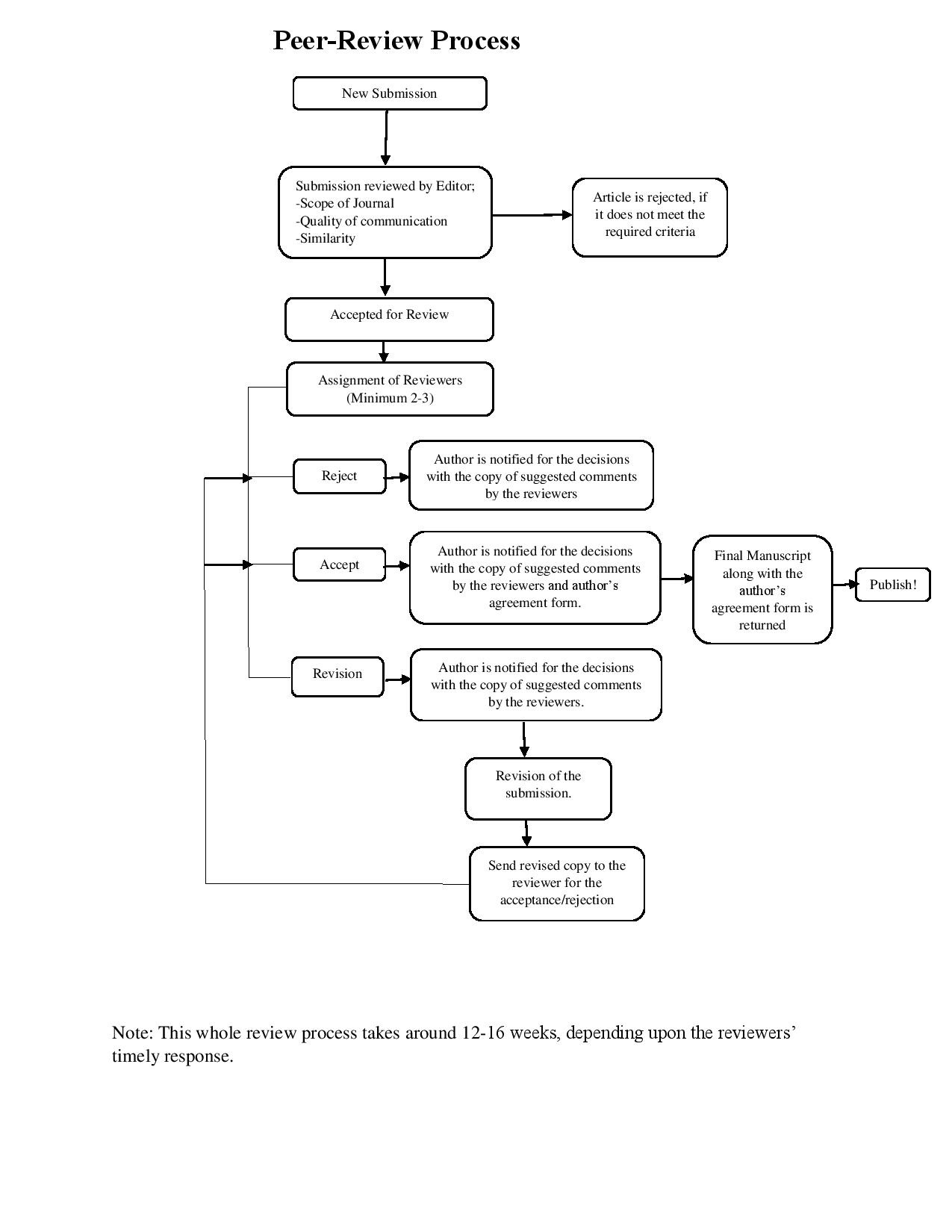
1. PEER-REVIEW PROCESS
The peer review process
facilitates a fair hearing for a manuscript among members of the scientific
community. More practically, it helps editors decide which manuscripts are
suitable for their journals. Peer review often helps authors and editors
improve the quality of reporting.
We believe that
manuscripts submitted to our journal are privileged communications that are
authors' private, confidential property, and authors may be harmed by premature
disclosure of any or all of a manuscript details.
Reviewers therefore are
asked to keep manuscripts and the information they contain strictly
confidential. Reviewers must not publicly discuss authors' work and must not
appropriate authors' ideas before the manuscript is published. Reviewers must
not retain the manuscript for their personal use and should destroy copies of
manuscripts after submitting their reviews to the editor.
Reviewers are expected to
respond to requests to review and to submit reviews within the agreed time
frame. Reviewer's comments should be constructive, honest, and polite.
(Note: The whole review
process takes around 08-10 weeks, depending upon the reviewers' timely response)
2. PUBLICATION
ETHICS POLICY AND PUBLICATION MALPRACTICE STATEMENT
2.1 ROLE OF EDITORIAL TEAM
2.2
EDITOR'S GUIDELINES
2.2.1 Publication
Decision
The editor of the JRP is
responsible for deciding which of the articles submitted to the journal should
be published. The editor may confer with other editors or reviewers in making
this decision.
2.2.2 Fair Play
An editor at any time
evaluate manuscripts for their intellectual content and contribution to the
existing knowledge, without regard to race, gender, religious belief, ethnic
origin, citizenship, or political philosophy of the authors.
2.2.3 Confidentiality
The editor and any
editorial staff of JRP must not disclose any information about a submitted
manuscript to anyone other than the corresponding author, and the reviewers.
2.3
REVIEWER'S GUIDELINES
2.3.1 Contribution to
Editorial Decision
Peer review assists the
editor in making editorial decisions and through the editorial communications
with the author may also assist the author in improving the paper.
2.3.2 Promptness
The review should be
carried out within the agreed timeframe. Further, any selected referee who
feels unqualified to review the research reported in a manuscript or knows that
its prompt review will be impossible should notify the editor and excuse
himself from the review process.
2.3.3 Confidentiality
Any manuscripts received
for review must be treated as confidential documents. They must not be shown to
or discussed with others.
2.3.4 Disclosure and
Conflicts of Interest
Privileged information or
ideas obtained through peer review must be kept confidential and not used for
personal advantage. Reviewers should not consider manuscripts in which they
have conflicts of interest resulting from competitive, collaborative, or other
relationships or connections with any of the authors, companies, or
institutions connected to the papers.
2.4
AUTHOR'S GUIDELINES
2.4.1 Reporting Standards
Research papers submitted
to JRP should be original and should not be under consideration to some other
publisher at the same time. Authors of original research should present an
accurate account of the work performed as well as an objective discussion of
its significance. Underlying data should be represented accurately in the
paper. A paper should contain sufficient detail and references to permit others
to replicate the work. Fraudulent or knowingly inaccurate statements constitute
unethical behavior and are unacceptable.
2.4.2 Data Access and
Retention
Authors are asked to
provide the raw data in connection with a paper for editorial review, if
practicable, and should in any event be prepared to retain such data for a reasonable
time after publication.
2.4.3 Originality and
Plagiarism
The authors should ensure
that they have written entirely original works, and if the authors have used
the work and/or words of others that this has been appropriately cited or
quoted.
2.4.4 Acknowledgement of
Sources
Proper acknowledgment of
the work of others must always be given. Authors should cite publications that
have been influential in determining the nature of the reported work.
2.4.5 Authorship of the
Paper
Authorship should be
limited to those who have made a significant contribution to the conception,
design, execution, or interpretation of the reported study. All those who have
made significant contributions should be listed as co-authors. Where there are
others who have participated in certain substantive aspects of the research
project, they should be acknowledged or listed as contributors.
2.4.6 Disclosure and
Conflicts of Interest
All authors should
disclose in their manuscript any financial or other substantive conflicts of
interest that might be construed to influence the results or interpretation of
their manuscript. All sources of financial support for the project should be
disclosed.
2.4.7 Fundamental Errors
in Published Work
When an author discovers a significant error or inaccuracy in his/her own published work, it is the author's obligation to promptly notify the journal editor and cooperate with the editor to retract or correct the paper.