1. Frequency of Publication
Iqra Journal of Health Sciences (IJHS) is a bi-annual research journal.
2. Guidelines for Submission of
Research Articles
- Submissions
to the journal are exclusively accepted through our online submission system,
Manuscript Editorial:(https://manuscripteditorial.com/jrp/login-new.php).
- We
do not entertain submissions via email or hard copies by post or hand delivery.
- To
assist authors in the submission process, we have provided comprehensive author
guidelines available at all times through this link: http://jrp.iurc.edu.pk/guidelines.php and this link https://manuscripteditorial.com/jrp/user-guide.pdf.
- Please
be aware that authors are required to adhere to ethical research practices,
submit without a cover letter, and ensure completion of the submission form.
- Upon initial submission, our team verifies the presence and completeness of all
necessary documents.
- Incomplete submissions are returned to authors for
completion, with a two-week window provided for this purpose.
- Failure to
complete the submission within this timeframe will result in automatic deletion
from the system without prior notice.
- We therefore urge authors to meticulously
fill out all required information in the online submission form.
3. Authorship of the Paper
- Authorship
should be limited to those who have made a significant contribution to the
conception, design, execution, or interpretation of the reported study.
- All
those who have made significant contributions should be listed as co-authors.
- In case besides the listed authors, other individuals have participated in
certain substantive aspects of the research project, they should be
acknowledged or listed as contributors.
- The corresponding author should ensure
that all appropriate co-authors and no inappropriate co-authors are included on
the paper, and that all co-authors have seen and approved the final version of
the paper and have agreed to its submission for publication.
4. Author Agreement Form
Submission
of work implies that the submitted piece has not been previously published.
Upon acceptance, the Author grants the journal the right to publish and
distribute the manuscript, either partially or entirely.
- The
Author's name will always accompany the publication of the manuscript.
- The
Author retains the following nonexclusive rights:
- To
utilize the manuscript in their teaching activities;
- To
include the manuscript in the Author's personal or departmental (but not
institutional) database or online platform; and
- To
license reprints of the manuscript to third parties for educational
photocopying.
- The Author also agrees to appropriately acknowledge the journal
as the original place of publication.
-
The corresponding
author will be required to fill and sign the Author Agreement Form which will
be shared along with the proof-reading document
5. Timeline of Publication
- Submission and initial review (within 01 week): Submitted articles are evaluated to ensure they fall within the journal's scope.
- First review (within 02 weeks): Submitted articles are sent for review.
- Article revision by the author(s) (within 02 weeks): Authors re-vise articles.
- Second review (within 02 weeks): Articles are sent for 2nd reviews.
- Final revision (within 01 week): Authors make final revisions.
- Acceptance and publication (within 01 week): Articles accepted for publication and issue published online.
- Additional revisions: If needed, authors given 02 weeks for each round.
6. Originality and Plagiarism Policy
JRP
uses Turnitin software to check the similarity of every manuscript. The authors
should ensure that they have written entirely original works, and they have
appropriately cited or quoted whenever they have used the works and/or words of
others. The acceptable range of the similarity index at JRP is less than 18%.
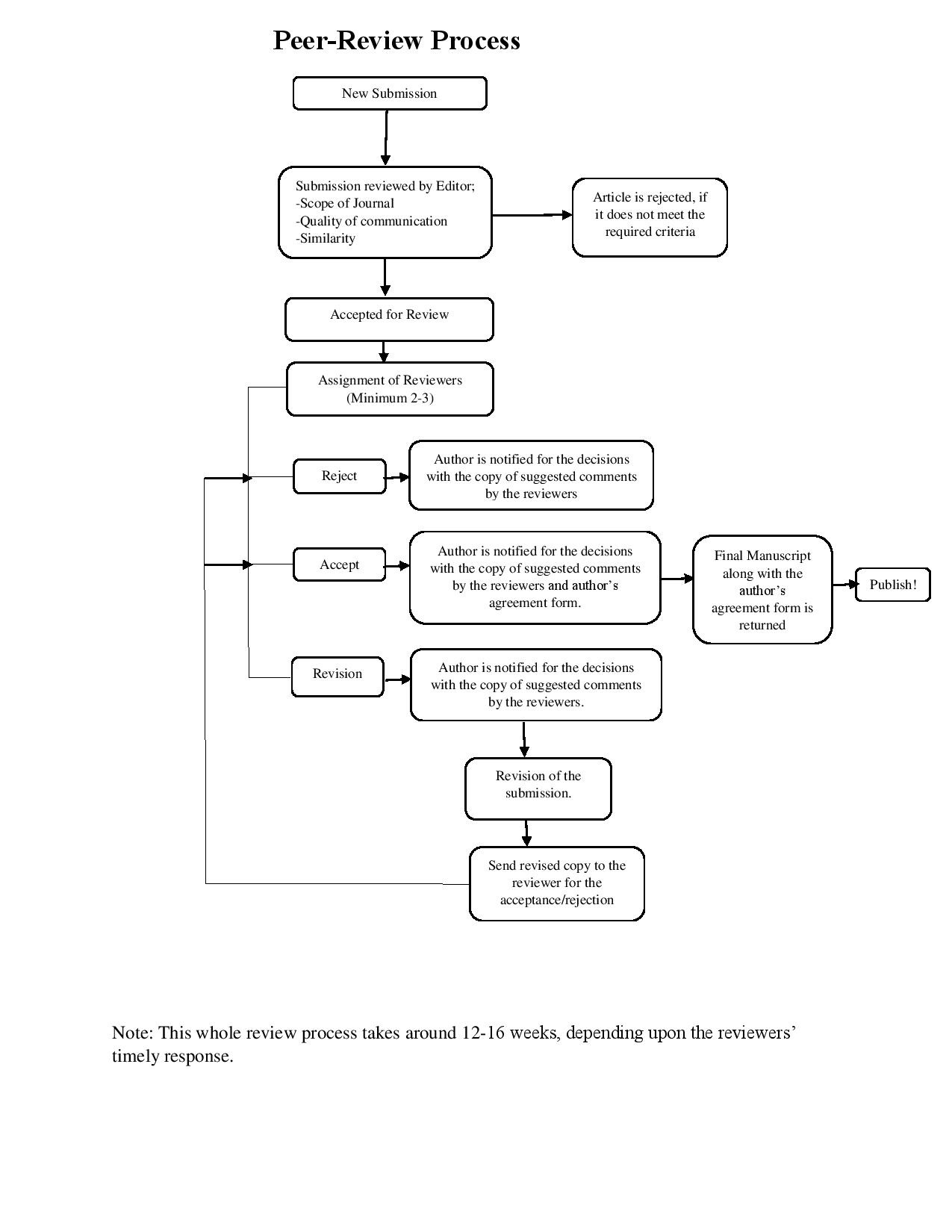
7. Peer Review Policy
The
peer review at JRP aims to facilitate a fair hearing for a manuscript among
members of the scientific community. We believe that manuscripts submitted to
our journal are privileged communications that are authors' private,
confidential property, and authors may be harmed by premature disclosure of any
or all of a manuscript(TM)s details.
- Reviewers
therefore are asked to keep manuscripts and the information they contain strictly
confidential.
- Reviewers must not publicly discuss authors' work and must not
appropriate authors' ideas before the manuscript is published.
- Reviewers must
not retain the manuscript for their personal use and must destroy copies of
manuscripts after submitting their reviews to the editor.
- Reviewers
are expected to respond to requests to review and to submit reviews within the
agreed time frame. Reviewers(TM) comments are required to be constructive, honest,
and polite.
(Note: The review process takes around 06 to 08 weeks depending upon the
reviewers' response.)
8. Article processing/publication fee
All
articles published in JRP are open access and freely available online,
immediately upon publication. JRP does not have article processing and
submission fee (APCs).
9. Ethical Guidelines
Authors
of original research should present an accurate account of the work performed
as well as an objective discussion of its significance.
- Underlying data should
be represented accurately in the paper.
- A
paper should contain sufficient detail and references to permit others to
replicate the work.
- Fraudulent or intentionally inaccurate statements
constitute unethical behavior and are unacceptable.
- The IRB/ERB report shall be
essential (if applicable) with the articles.
10. Data Access and Retention
Authors
are asked to provide the raw data in connection with a paper for editorial
review, if applicable. They should be prepared to retain such data for a reasonable
time after publication.
11. Disclosure of Conflicts of
Interest
All
authors should disclose in their manuscript any financial or other substantive
conflict of interest that might be construed to influence the results or
interpretation of their manuscript. All sources of financial support for the
project should be disclosed.
12. Corrections and Retractions of
Research Articles
After
a paper is published, we generally do not allow making any changes to the
paper. However, the editorial board may allow corrections in the published paper
in exceptional cases.
- The
corrections may be allowed to rectify unintentional miscalculations, human
lapses or technical errors in the published paper.
- The
published papers may be retracted if clear evidence of fraudulent data,
plagiarism or unethical publication practices is found.
- The
copyright infringement or non-disclosure of conflict of interest may also
result in retraction of the published papers.
- The
decision of the editorial board with regards to correction or retraction will
be final and cannot be challenged.
13. Acknowledgement of Sources
Proper
acknowledgement of the work of others must always be made. Authors should cite
publications that have been influential in determining the nature of the
reported work.